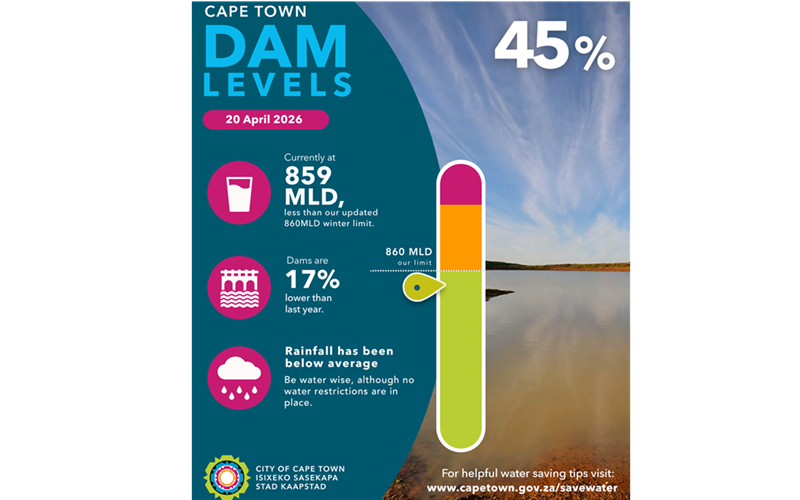
Water savings at your fingertips, Cape Town’s dam levels 45%
22 April 2026
Rain or no rain, Team Cape Town, we need to work together to save water. While the recent rainfall is welcome, it has only marginally increased dam levels, reminding us that we cannot depend on unpredictable rainfall alone to secure our water supply. Within the next six weeks, based on the current water usage trend, dam storage could drop to as low as 40% by May if this year’s rainfall is average. Swopping baths for short-stop showers to checking and fixing leaks on our properties are some tips to help keep our dams fuller for longer, so that we can avoid water restrictions being implemented sooner than the end of this year.
Team Cape Town, we all need to use less water so that together we can manage our current 45% dam levels that will need to last possibly until next year, without depending on unpredictable rainfall this year.
Consumption statistics confirm that currently, 70% of water being used in high volumes is at home.
Residents are central to changing this trajectory, here are the top water saving tips:
Overall:
1. Find and fix water leaks on your property.
Take a moment, turn off all taps and go to your water meter. If it is still moving, you likely have a leak.
2. Monitor your own usage and make the effort to save water.
Indoors:
3. Don’t flush in a rush.
Only flush when necessary and do not use your toilet as a bin.
New or replaced toilet cisterns may not exceed six litres for each flush.
4. Take short, stop-start showers or small baths.
The maximum flow rate of new and replaced showerheads may not exceed seven litres.
5. Wash more with less, for laundry and dishes.
Only wash clothes and dishes (pots, cups etc) when really needed. Wait for a full load before using washing machines and dishwashers. Hand washing and spot-cleaning can use less water.
6. Turn off taps when not using the flow.
Eg. Use a cup for shaving and brushing your teeth.
Outdoors:
7. Close the hose when washing the car. Hosepipes for washing vehicles must be fitted with a trigger nozzle. Stop-start your spray as you need it, and don’t spray more than you need. Alternatively, bucket-wash your vehicle, invest in a high pressure/low flow cleaner or have your vehicle cleaned professionally.
Water gardens wisely:
8. Dial back irrigation timers now. The season is changing and your garden needs far less water.
9. Don’t let your hosepipe run wild. Fit a trigger nozzle and spray only on demand.
10. Beat the heat loss. Only water before 09:00 or after 18:00 to avoid evaporation losses.
11. Water down to the roots directly where possible.
12. Keep outdoor fun water wise. Supervise careful use of water for children’s play, and cooling on hot days. E.g. Use a wet cloth to cool down hot skin, and avoid wasteful spraying of water.
13. Keep the pool full for longer with a cover. Built-in and portable pools must be covered to avoid evaporation when not in use. Recycle the backwash, and top up with rainwater or alternative water where possible.
Did you know?
Water tariffs are structured to reward lower consumption and encourage saving.
Most residential water is billed on a sliding scale, meaning the more you use, the higher the cost per kilolitre (1,000 litres) per month. Current Domestic Full Non Indigent tariffs (including VAT) are:
- R24.32 for the first 6 kl
- R33.42 for usage between 6 and 10.5 kl
- R49.96 for usage between 10.5 and 35 kl
- R96.37 for usage above 35 kl
By using less water, you can stay in the lower tariff bands and significantly reduce your monthly bill. Check your municipal account to see which tariff bands (steps) apply to your current consumption.
Current dam levels and how much water Cape Town has used
Over the past week, water usage has decreased to 859 million litres of water a day (MLD) from 970 MLD last week.
This is one MLD below the new winter usage target of 860 MLD.
Cape Town’s dam storage levels currently stand at 45%.
Cape Town’s water status in a nutshell:
- Everyone living, working and visiting Cape Town needs to be water wise, especially between now and the end of May so we have more water stored ahead of the uncertain winter rainfall, which is predicted to be less than average.
- Cape Town is not in a drought, and not heading to ‘Day Zero’. However, Cape Town is in the early warning phase that reflects lower-than-expected dam levels and signals the need for continued careful use of water. The window to avoid water restrictions before November is narrowing as our collective usage remains high.
- The City may, based on its own assessments of water usage, dam levels and long-term weather forecasts, propose water restrictions before the next Annual Operating Analysis that is done by the National Department of Water and Sanitation (DWS) in November. The City is and will continue to closely monitor dam levels and water use closely.
Team Cape Town, let’s continue to save water together
‘While we welcome this weekend’s rainfall, it unfortunately only slightly increased dam levels by 0,2%. This reiterates that we cannot depend on unpredictable rainfall to fill our dams. While rainfall is vital, it also has to rain in the right place, in our dam catchments for dam levels to increase. The recent rains also largely wet the ground and did not generate much runoff into the dams.
 ‘Let’s continue to save water even when it rains. Saving water today, means saving water for tomorrow and the months ahead.
‘All of us need to use water wisely at all times, especially now, so we can collectively keep our dams fuller for longer. If we use more than this winter target of 860 MLD, followed by another below average rainfall this winter, the City may have to implement water restrictions by the end of this year, if not sooner to help conserve our supply. This step would be a last resort.
‘Team Cape Town, we all use water every day so we all need to do so wisely and responsibly in and around our homes, businesses and industries, and for essential purposes only. Every drop counts ahead of unpredictable winter rainfall,’ said Councillor Zahid Badroodien, Mayoral Committee Member for Water and Sanitation.
Reminder:Report burst municipal pipes immediately to the City through formal channels.
There are various ways to report a leak or a pipe burst:
Please provide an exact location or address and always insist on a reference number.
Information:
1. Water saving tips can be found on the
City's website.
2. See the
City’s action plan to be water-wise and build Cape Town’s water secure future.
3. Listen to the
media briefing held on Wednesday 25 February.
Caption 1: Dam levels update infographic
Published by:
City of Cape Town, Media Office